The Constitutional and Law Reform Commission (CLRC) and the University of Papua New Guinea (UPNG) have formalised a landmark partnership through the signing of two Memorandum of Understanding (MOUs) that will preserve one of Papua New Guinea’s most significant constitutional landmarks and strengthen the development of the nation’s Underlying Law.
Signed at UPNG, the agreements establish a collaborative framework for the rehabilitation and preservation of the Constitutional House on Motupore Island and the establishment of an Underlying Law Centre within the UPNG School of Law.
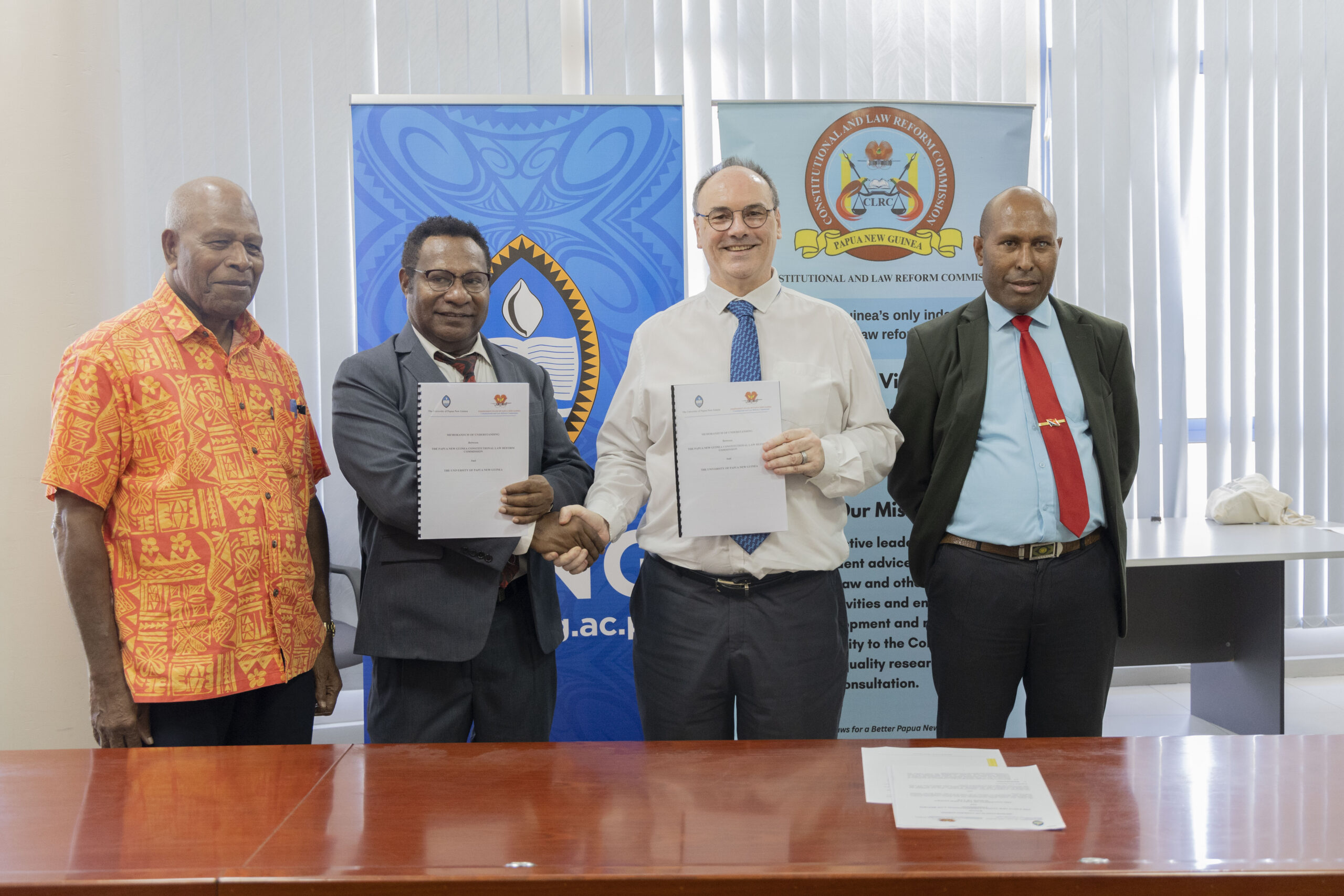
L-R: UPNG Executive Dean of the School of Natural and Physical Sciences Professor Simon Saulei; CLRC Secretary Dr. Mange Matui; UPNG Vice Chancellor Professor Ian Findlay; and CLRC Deputy Secretary for Corporate Services Mr. Xavier Winnia posing with the signed MOUs.
The first MOU authorises the CLRC to rehabilitate and preserve the Constitutional House, which is situated on Motupore Island and managed by UPNG through its Marine Sciences Research Centre.
The Constitutional House holds immense national significance as the venue where the Constitutional Planning Committee (CPC) undertook much of its work in developing Papua New Guinea’s Constitution between 1972 and Independence in 1975. As the successor to the CPC, the CLRC continues to uphold that legacy through its core mandate in law review and reform, ensuring that the voices of Papua New Guineans continue to shape the country’s legal framework.
Through this partnership, both institutions will work together to restore and preserve the Constitutional House as a national heritage site, providing future generations with an opportunity to appreciate the vision of the nation’s Constitutional Fathers while supporting historical research, education and civic learning.
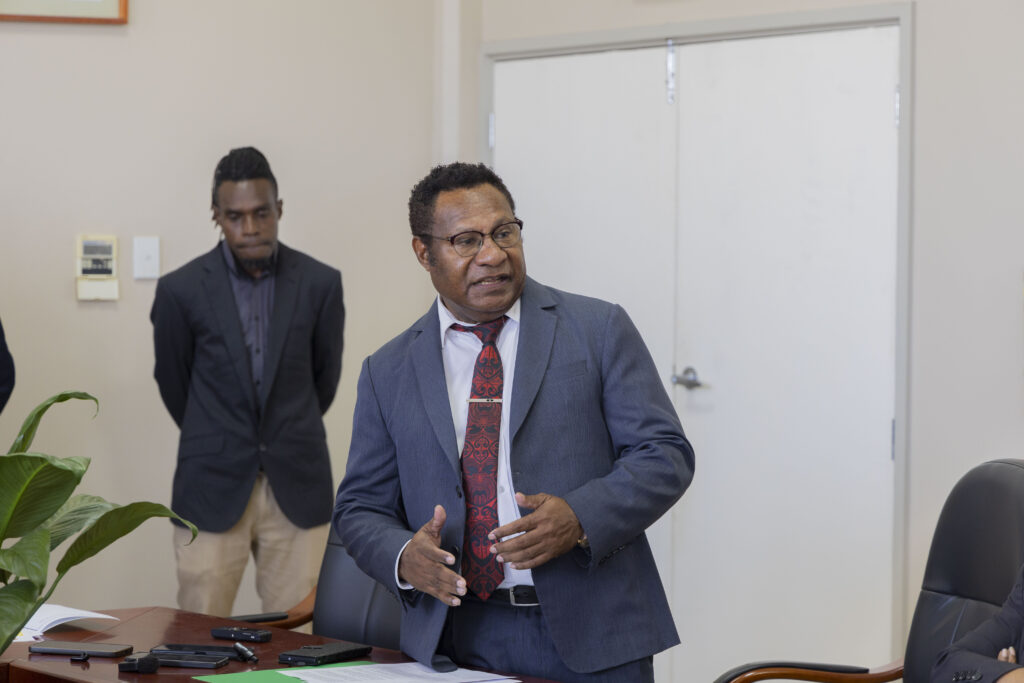
CLRC Secretary, Dr. Mange Matui, said the partnership reflected a shared commitment to preserving one of Papua New Guinea’s most important national institutions.
“This signing is much more than the commencement of a restoration project. It is a reaffirmation of our collective responsibility to preserve the birthplace of Papua New Guinea’s Constitution, honour the legacy of our founding leaders, and safeguard one of our nation’s most treasured landmarks for generations to come.”
Dr. Matui said the Commission’s long-term vision extended beyond restoring the building itself.
“Ultimately, our vision extends beyond restoring a historic building. We envision the Constitutional House becoming a place where students, researchers, public servants, legal professionals and visitors can learn about the history of our Constitution, appreciate the work of the Constitutional Planning Committee, and reflect upon the enduring values that continue to unite us as a nation.”
The second MOU reinforces the Commission’s statutory responsibilities under the CLRC Act 2004 and the Underlying Law Act 2000 to promote, develop and monitor Papua New Guinea’s Underlying Law.
Under the agreement, an Underlying Law Centre will be established within the UPNG School of Law. The Centre will store and feature CLRC publications, including custom recording reports, underlying law conference papers, seminar reports and other research materials relating to customary law and the development of the Underlying Law.
The Centre will provide students, academics, legal practitioners, judges, researchers and the wider public with direct access to valuable legal resources that support research, teaching and the continued development of Papua New Guinea’s unique legal system.
To support the establishment of the Centre, the Commission presented a cheque of K50,000 to the UPNG School of Law to commence preliminary works.
UPNG Vice-Chancellor, Professor Ian Findlay, welcomed the partnership, describing the two agreements as complementary initiatives that honour the nation’s past while investing in its future.
“I am very pleased to sign these two MOUs. One recognises the history and heritage of the development of Papua New Guinea’s Constitution, while the other looks to our future by strengthening legal scholarship and supporting the continued development and review of our laws.”
Professor Findlay said the two initiatives reflected the dual role of legal education in preserving history while shaping future generations of legal professionals.
“One MOU looks to our past by preserving the Constitutional House and honouring our history. The other looks to our future through the continued development of our laws. Together, they represent exactly what a law school should aspire to achieve.”
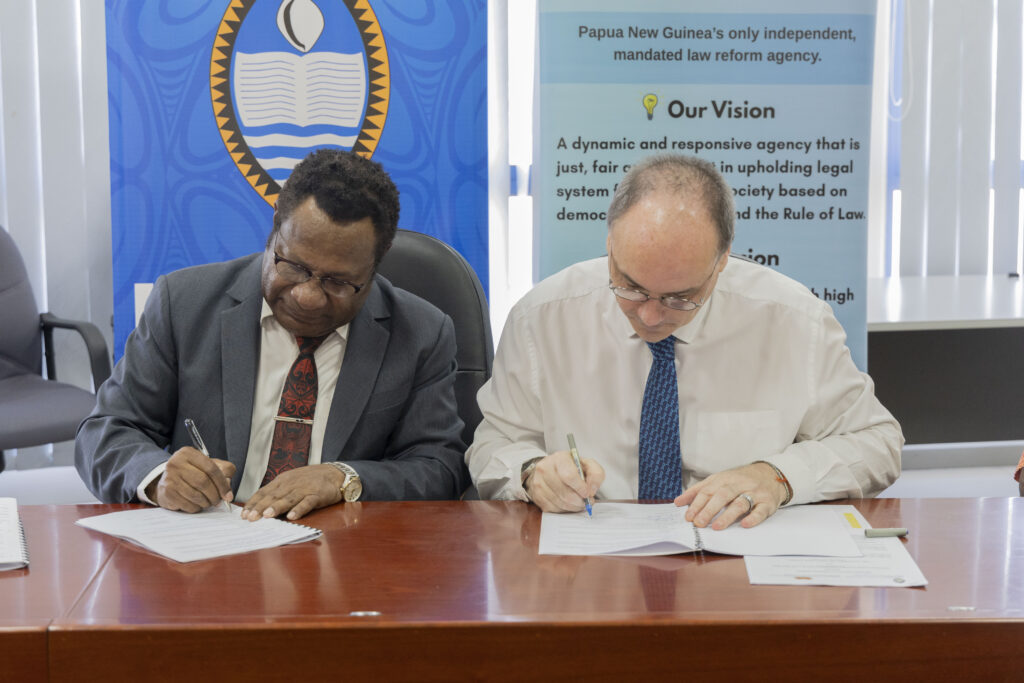
The MOUs were signed by CLRC Secretary Dr. Mange Matui and UPNG Vice-Chancellor Professor Ian Findlay, witnessed by senior management representatives from both institutions.
While committed to its core mandate in law review and reform, the partnership reflects CLRC’s broader commitment to preserving the nation’s constitutional heritage while strengthening institutions that contribute to the development of the Constitution and the Underlying Law for future generations.