CLRC Advances Discussions to Preserve Historic Constitutional House
CLRC Advances Discussions to Preserve Historic Constitutional House
In 2025, the Constitutional and Law Reform Commission (CLRC) reaffirmed its commitment to safeguarding Papua New Guinea’s constitutional heritage by initiating discussions with the University of Papua New Guinea (UPNG) on the possible restoration and redevelopment of the historic Constitutional House, located on Motupore Island.
The discussions, which remain at an exploratory stage, were prompted by growing public concern over the deteriorating condition of the building, including issues highlighted in a media article published by The National in March 2025. CLRC Secretary Mange Matui acknowledged these concerns and confirmed that the Commission had taken note of the issues raised.
“These discussions are still in the infant stages, and no final decisions or agreements have been made at this time,” Dr. Matui said, adding that the concerns surrounding the condition of the building were valid and required attention.
Engagements with UPNG, as the caretaker and owner of the property, are aimed at establishing a formal understanding between the two institutions to preserve the site for educational and historical purposes. Such collaboration is expected to ensure that the necessary space, coordination, and resources are available should restoration works proceed in the future.
The Constitutional House holds deep national significance as the venue where members of the Constitutional Planning Committee (CPC) convened to deliberate and draft the Constitution of Papua New Guinea, prior to its adoption by the Constituent Assembly in September 1972. The site stands as a powerful symbol of the country’s journey toward independence and democratic governance.
As Papua New Guinea approaches its 50th Independence Anniversary, CLRC has underscored the importance of recognising and preserving such historically significant sites. The Commission views the Constitutional House as a national monument deserving of protection and consideration within broader independence commemorations.
CLRC has further expressed a strong moral and institutional responsibility to support the preservation of the building, given its direct historical linkage to the CPC. The CPC is widely regarded as the Commission’s primary predecessor, and the work undertaken within the Constitutional House continues to inform CLRC’s mandate today.
The CPC played a pivotal role in guiding the creation of the Constitution and shaping the legal, political, and governance framework of an independent Papua New Guinea through nationwide consultations and the decolonisation process. These responsibilities continue through CLRC’s
work as the country’s sole law reform agency, ensuring that laws remain responsive to contemporary realities while grounded in the nation’s constitutional values.
Through these early discussions, CLRC has demonstrated its intent to honour the legacy of the nation’s constitutional architects while contributing meaningfully to the preservation of an iconic symbol of Papua New Guinea’s constitutional history.
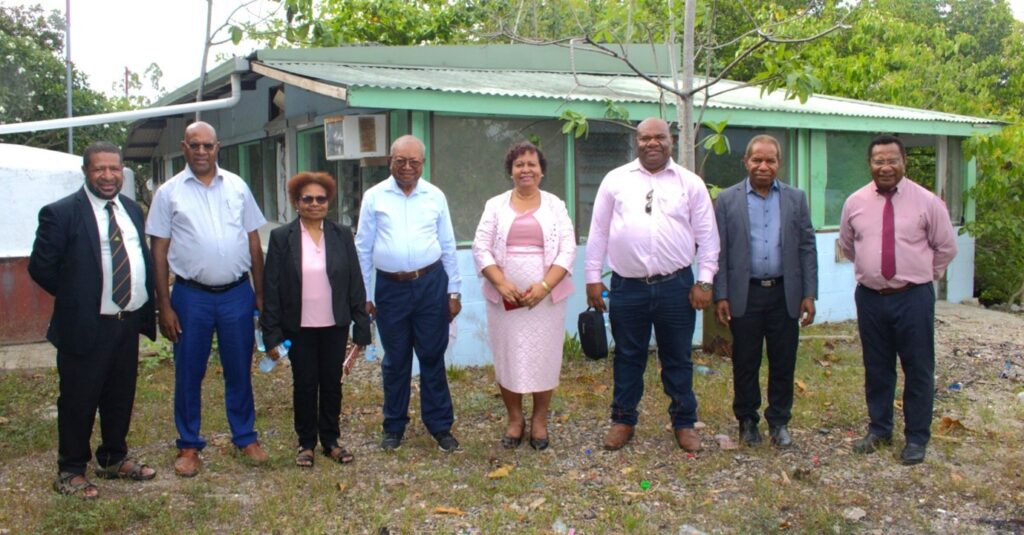
Insert (L-R): CLRC Chairman Hon. Saki Soloma and Commissioners Hon. Johnson Wapunai, Dr. Dora Kuir-Ayius, Prof. Sam Kaipu, Ms. Martha Kokiva (Deputy Chairperson), Hon. Freddie Kumai, Rev. Dr. Jack Urame and CLRC Secretary Dr. Mange Matui – at the Constitutional House at Motupore Island.